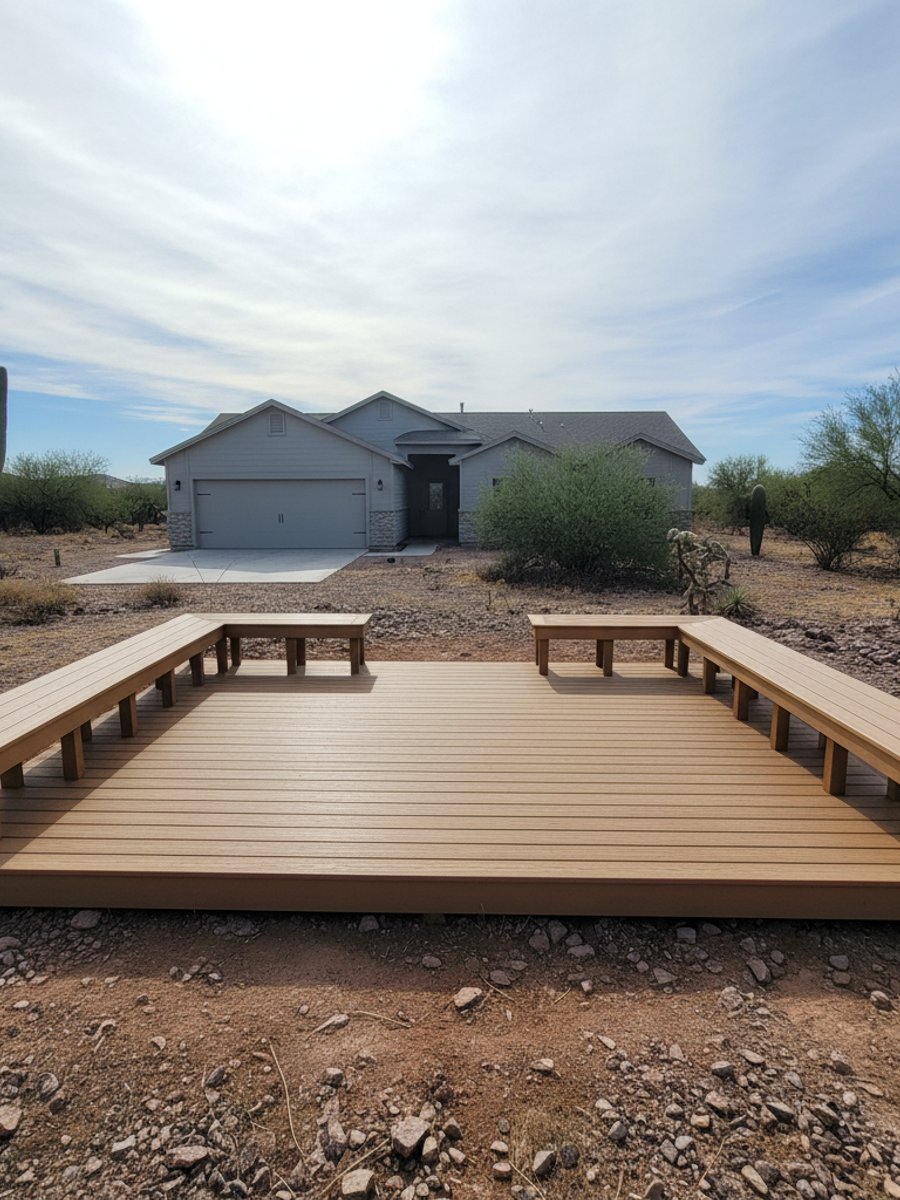
Phoenix doesn't really have four seasons for outdoor construction. It has one long stretch where the materials cooperate and one where they fight you. If you're planning any kind of deck work, from a full rebuild to just resealing the boards you already have, the calendar matters more here than it does almost anywhere else in the country.
Why heat changes what the wood and concrete actually do
Pressure-treated lumber ships with a certain moisture content, and it keeps losing water as long as the air around it is dry and hot. Install joists and decking in June or July, when surface temperatures on exposed wood can run 40 to 50 degrees above air temperature, and the boards shrink hard as they finish drying out. Screws that were snug in July can be sitting in a gap by October. Build the same deck in November through February, when daytime highs sit in the 65 to 75 degree range, and the wood has already lost most of that moisture slowly, outdoors, at the lumberyard and job site both. Less shock to it means fewer split ends and popped fasteners a year later.
Concrete footings have the opposite problem in summer. Pour a footing when it's 112 degrees out and the surface can skin over and cure faster than the concrete underneath, which leads to surface cracking and a weaker bond overall. In summer we're covering fresh pours with wet burlap and hitting them with water two or three times a day just to slow the cure down to something normal. In January that same footing cures at a reasonable pace with almost no babysitting.
Composite decking has its own rulebook
Composite boards expand and contract with temperature more than real wood does. Manufacturers publish a gap spacing chart tied to the temperature at install, usually somewhere between 1/8 and 3/16 inch depending on the board and the day. Install composite decking on a 115 degree afternoon with the boards already at their most expanded, gap them too tight, and you'll get buckling the first cold snap in January when they pull back. Install in cooler months and you have to run the numbers the other way, leaving enough room for July. Either way it's a calculation, not a guess, and it's one more reason fall and spring installs tend to look better five years out.
Monsoon season is its own category
From roughly July through September, Phoenix gets sudden downpours, dust storms, and wind gusts that show up with almost no warning. That's a bad window for anything involving a ladder, an open trench, or a pergola frame that isn't fully braced yet. It's also a bad window for staining and sealing. Most penetrating sealers need 24 to 48 hours of dry weather to cure before rain hits them, and a monsoon cell doesn't always respect a forecast. Demolition and removal work is less picky about weather and can happen almost any month, since you're taking something apart rather than asking a fresh material to cure or bond.
Staining and sealing want mild sun, not none
A lot of homeowners assume winter is automatically best for every job, but sealing has its own narrow window too. Apply an oil-based sealer in direct summer sun and it can flash-dry on the surface before it soaks into the grain, leaving a film that peels within a season. Apply it on a 95-degree morning before 9am, or on a mild 70-degree day in November or March, and it has time to actually soak in. We generally treat staining and sealing as an early-morning job from about April through October, and a more flexible any-time-of-day job the rest of the year.
The ground here isn't like most places
A good amount of the Phoenix valley sits over caliche, a hard, cemented layer of calcium carbonate that can start a foot or two down and behaves more like soft concrete than soil. Footings that hit a caliche layer often need to be broken through with a jackhammer or auger attachment rather than a hand shovel, which changes both the timeline and the cost of a new post footing. It's easier and more predictable to deal with in cooler months, when a crew isn't also fighting heat exhaustion on top of a caliche layer. In neighborhoods built on old farmland east of the city, drainage and soil moisture can vary from lot to lot depending on what was graded and filled decades ago.
Permits, inspections, and HOAs
Most attached decks in the Phoenix area need a permit through the local city or county building department, with an inspection of the footings before they're covered and a final inspection of the ledger attachment and railing. If your property is in one of the many Phoenix-area HOAs, common in places like Ahwatukee, Anthem, or the newer subdivisions around Gilbert and Queen Creek, expect an architectural review step before the permit even gets filed. Spring is the busiest season for permit offices here, since everyone wants their deck finished before summer, so a project started in March can sit in review longer than the same project filed in October. Planning a build for the cooler months isn't only about the weather, it's about getting through the paperwork faster too.
What this means for scheduling your project
If you're building new, repairing structure, or installing composite boards, October through April is the stretch where materials behave the way they're supposed to and crews can work a full day without heat breaks eating half the schedule. If you're staining, sealing, or resurfacing something you already have, that window is a little wider, since you can chase the early morning hours through most of the year except peak monsoon season. Demolition doesn't care much either way.
None of this means summer work is off the table. It means more water on fresh concrete, tighter attention to gap spacing on composite boards, and staining scheduled before 9am instead of at noon. If you want a straight answer on what your project calls for and when, Midway Deck Solutions can walk the site with you and lay out what the calendar actually allows for the job you have in mind.